
Closures: AI-Powered emergency routing
Closures uses AI to process incoming information about road closure and turn it into actionable routing data, directly reflected in Vehicle Services. Using hyper-local information to help reduce response times.
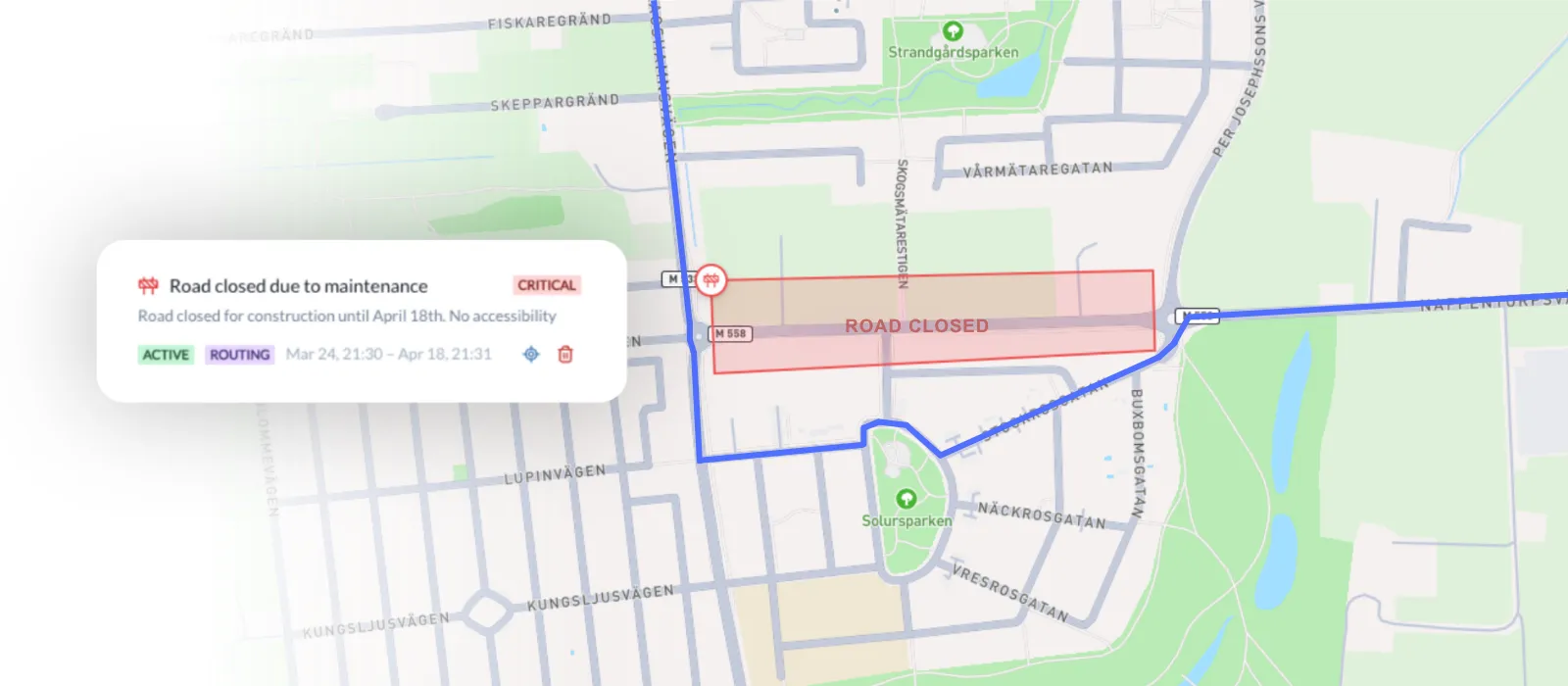
Routing is a critical part of emergency response.
Modern navigation systems take real-time traffic data into account. But they can miss hyper-local information, such as temporary road closures, blocked access routes, or other on-the-ground changes. Missing this type of information can directly affect response times.
Information about road closures and access restrictions is often received via email, for example from municipalities, but it is not reflected in routing. Evam Closures is an AI-powered tool designed to address this gap, giving agencies full control over how their vehicles are routed to incidents.
Powered by AI
Using AI, the system can process incoming information, for example from emails, and suggest a road closure or restricted area, ensuring that vehicles are not routed through them. An administrator can review, adjust, or approve the suggested closure in the web interface before it is applied. Once approved, it is directly reflected in routing within Vehicle Services.
Bringing routing closer to reality
With Closures, routing becomes something that can be actively managed. From a web interface, agencies can create and manage restricted roads and areas, making sure vehicles are not routed through them during incidents.
Road closures can be configured with time windows, allowing agencies to define both permanent and temporary restrictions.
Once the defined time period has passed, closures are automatically removed and routing is updated accordingly. RouteControl minimizes re-routing during incidents and lowers the need for manual coordination. It also ensures that all units operate from the same, up-to-date information, making response more predictable and ultimately reducing response times.
No other articles yet.